Agentic AI Has Entered Its Engineering Era
Share this article:

Building engineering systems and platforms at scale. Full-stack development, system design, and software architecture.
Agentic AI Has Entered Its Engineering Era: The Agent Harness with AWS
The Prototype Phase Is Over
For the last year, many organisations have been experimenting with AI agents. Building demos was easy. Getting them secure, observable, governed, scalable, and production ready was the hard part.
That is where the next engineering shift is happening.
The release of Amazon Bedrock AgentCore Harness is another signal that AI is moving from:
❌ "Look what this agent can do"
to
✅ "How do we reliably run thousands of agent workflows in production?"
Intelligence Engineering is the New Discipline
The future of AI will not only belong to teams who can create prompts. It will belong to teams who can engineer intelligence.
The new AI engineering discipline requires five core pillars:
🔹 Agent Lifecycle Engineering
Taking an idea → prototype → production workload with proper deployment patterns.
This mirrors how we evolved infrastructure from manual servers to Infrastructure as Code. Now we need the same discipline for agent workflows:
- Idea to prototype in minutes
- Standardized deployment patterns
- Automated testing and validation
- Rollback and versioning strategies
🔹 Observability by Design
You cannot operate what you cannot see.
Agent decisions, tool usage, latency, failures, token consumption, and quality need the same engineering discipline we expect from distributed systems.
Key metrics to observe:
- Agent decision traces and reasoning paths
- Tool invocation patterns and failures
- Token consumption and cost per execution
- Latency and performance bottlenecks
- Quality and accuracy of agent outputs
🔹 Security & Governance Built In
Identity, permissions, data boundaries, access control and responsible usage cannot be an afterthought.
As agents become more autonomous and make more decisions, security governance becomes critical:
- Agent identity and authentication
- Fine-grained permissions for tool access
- Data boundaries and isolation
- Audit trails for compliance
- Responsible AI guardrails
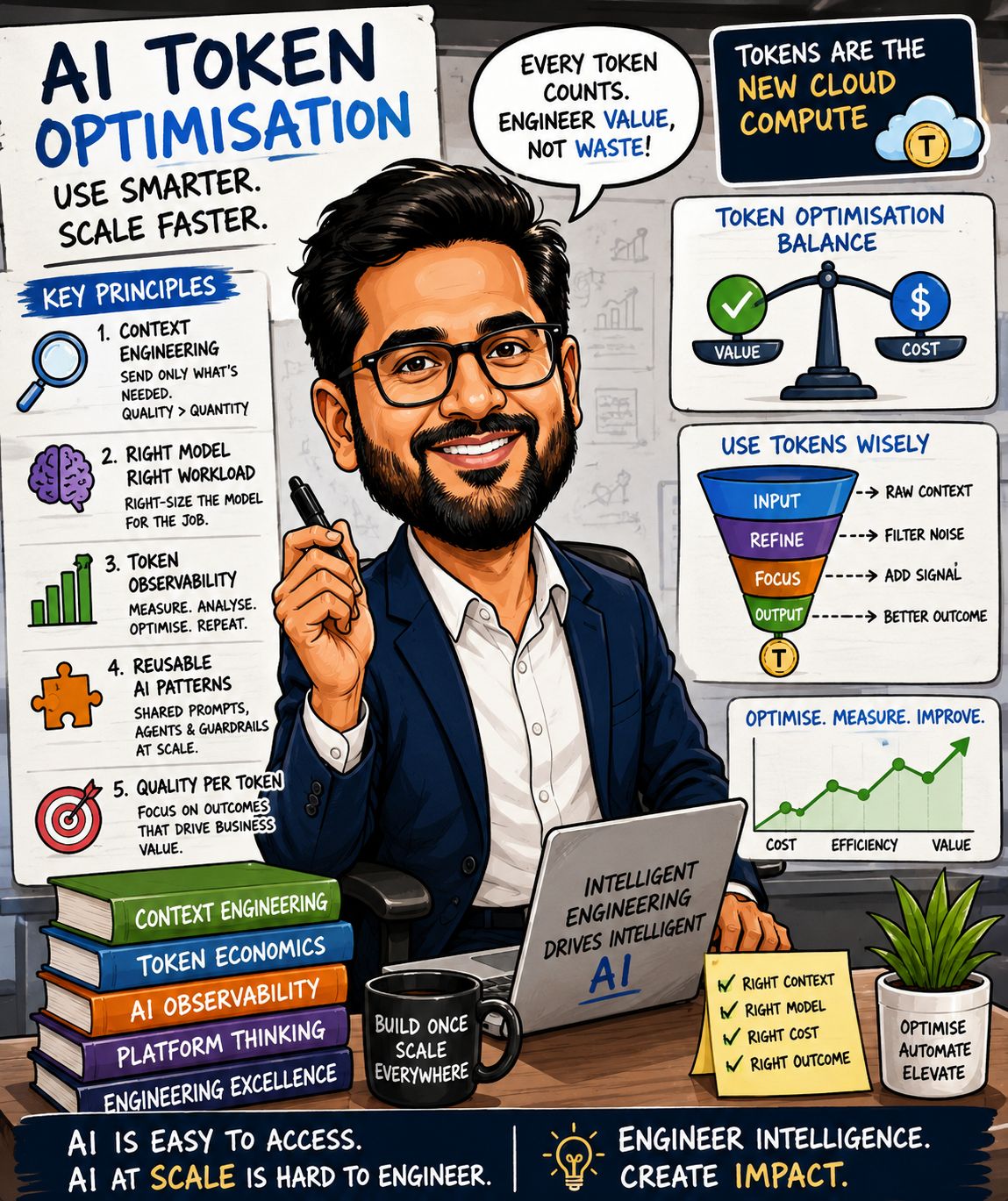
🔹 Cost Engineering for Intelligence
The new cloud optimisation frontier is no longer only CPU, memory and storage.
It is:
- Tokens - Tracking and optimizing token usage per agent execution
- Context windows - Smart context management and retrieval
- Model selection - Right-sizing models for different workloads
- Agent execution paths - Optimizing decision trees and branching logic
- Intelligent caching - Reducing redundant computations
- Business value per inference - Measuring ROI of each agent decision
🔹 Platform Thinking for AI
The winning companies will not build one successful AI agent.
They will build the platform that allows hundreds of safe, reusable and governed agents to exist.
This is the same evolution we saw with cloud:
Servers → Infrastructure as Code → Platforms
Now we are seeing:
Prompts → Agents → Intelligence Platforms
The Evolution Continues
The next generation of engineers will not just write software.
They will design systems that reason, learn, interact and continuously improve.
The Question Changes
Welcome to the era of Intelligence Engineering.
The question changes from:
"How fast can we build an AI agent?"
to
"How confidently can we operate intelligence at enterprise scale?"
This shift represents a fundamental change in how we approach AI. It's no longer about what AI can do—it's about how reliably and safely we can operate it in production at scale.
The companies that master this engineering discipline will win in the AI era.